


From Infrastructure to Lending: The Strategic Synergy Between SkipCash and PayLater
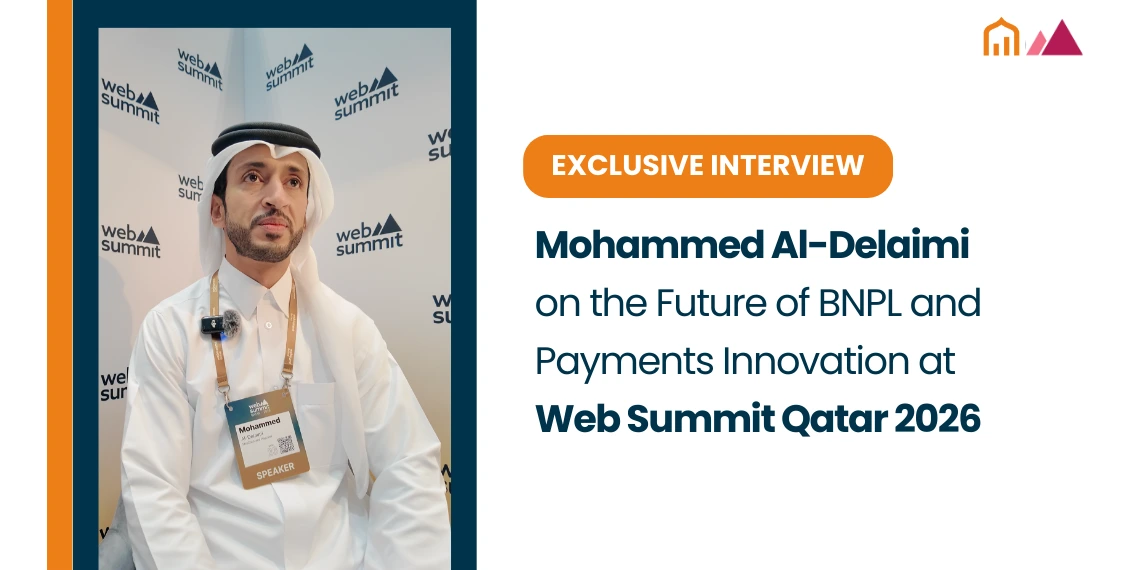
Our contributor, Abdul Qavi sat down with Mohammed Al-Delaimi at Web Summit Qatar 2026 in Doha. The third edition of this marquee technology and innovation conference brought more than 30,000 founders, investors, policymakers, media professionals, and entrepreneurs from over 120 countries to the Doha Exhibition and Convention Center from February 1 to February 4, 2026. The event featured over 1,600 startups, 800 investors, and 400 speakers, making it the largest tech gathering in the Middle East to date and a focal point for discussions on digital transformation and regional startup ecosystems.
Mohammed Al-Delaimi, founder and managing director of SkipCash and co-founder of PayLater, is at the centre of two high-growth fintech ventures that exemplify the region’s rise in payments and consumer finance innovation. Our conversation explored how he manages dual businesses at different maturity stages, the regulatory environment in Qatar, and the future of Buy Now Pay Later (BNPL) services in the Gulf.


Momentum, Funding and Strategic Clarity
Building Two Companies at Two Different Stages
Rasmal: Mohammed, congratulations on what is clearly a rare milestone. You announced a USD 10 million Seed round for PayLater and a USD 4 million Series A for SkipCash almost at the same time. Most founders struggle to build and fund one startup, let alone two operating at different maturity stages. How do you conceptually separate the growth engines of these two businesses?

Mohammed Al-Delaimi: It has definitely been a challenging journey, but I think the foundation we built with SkipCash made this possible. From day one, our focus was not only on running the business but on building processes, governance, and structure. Many startups struggle at that stage, but once the processes are right, scaling, no matter the transaction volume, becomes more manageable and organized.
SkipCash is fundamentally a payments solution provider, and optimization and orchestration are at the core of what we do. Over the last five years, we earned the trust of thousands of businesses that depend on our platform. At a certain point, I felt SkipCash had reached a level of maturity where it was ready to scale into new markets.
“That maturity created room for a second opportunity, PayLater. This does not mean SkipCash no longer has challenges, but the team, talent, and experience we built there are now capable of handling growth and expansion independently.”
PayLater came at the right moment, and I did not want to miss that opportunity. PayLater was founded with three other partners, and we joined as SkipCash, bringing our fintech experience, regulatory knowledge, and operational expertise into the company from day one.
Infrastructure and Consumer Habit
Rasmal: So would it be fair to say that SkipCash today functions as the infrastructure layer, while PayLater is shaping consumer financial behavior, with both potentially evolving toward a super-app model over time?
Mohammed Al-Delaimi: Yes, that is a very accurate way to describe it. PayLater is a key strategic client of SkipCash. We do not just provide payment services, we actively help optimize their payment orchestration and operational setup.
The challenge with PayLater is that BNPL is a much more complex ecosystem. You are dealing with consumers, merchants, regulators, credit facility providers, investors, and partners, all at the same time. Aligning the narrative and incentives between all these stakeholders is the real challenge.
Today, SkipCash has 32 team members, and PayLater has 21. Both are still relatively lean teams, but we intentionally brought talent from different parts of the region. Our PayLater CEO, Dr. David, comes with deep banking and payments experience from the UAE, including Noon Payments. Our product leadership has experience from Indian banks offering BNPL, and our partnerships team includes ex-bankers from Qatar.
Managing two startups is challenging, but the strength of the teams makes it possible.
The Fintech “Dual Engine”
How Mohammed Al-Delaimi Structures Two Startups
Regulatory Maturity and Speed
Rasmal: One striking contrast is licensing speed. SkipCash took nearly two years to be licensed, while PayLater was licensed in about eight months. What changed?
Mohammed Al-Delaimi: I believe the regulator itself has evolved significantly. There is more experience, more hands-on involvement, and a genuine intent to support fintech growth. Of course, I do not blame the regulator for taking time; this is people’s money, and everything must be fully compliant, resilient, and operationally sound.
But when regulators see a serious team, a clear business model, and strong governance, they become partners rather than obstacles. Closing one of the largest Seed rounds in Qatar is a reflection of that trust, and Inshallah it will help us scale responsibly.
The Significance of the LuLu Investment
Rasmal: PayLater’s Seed round was led by LuLu Alternative Investments, which is not just financial capital but strategic retail capital. Does this investment imply exclusivity? Should the market expect PayLater to become the default BNPL option across LuLu stores in the region?
Mohammed Al-Delaimi: Several parties participated in the round: LuLu Alternative Investments, Qatar Development Bank, two family offices, and angel investors. LuLu moved quickly because they already understood the impact of BNPL on retail performance.
Their experience with BNPL platforms like Tabby and Tamara in the UAE showed them how BNPL increases sales volume and average basket size, while unlocking new customer segments. Qatar is particularly interesting because reports from Visa and Mastercard show that average transaction sizes in Qatar are higher than elsewhere in the GCC.
This is not about exclusivity. It is about early belief and strategic alignment. LuLu saw BNPL as a tool for controlled and responsible spending, and they wanted to be part of that journey early.
QAR 300 Million in Transactions: What Are People Actually Buying?
Rasmal: PayLater processed QAR 300 million in transactions in under a year, which is remarkable for a seed-stage company. When you analyze that data, what are Qatari consumers actually buying? Are you seeing a shift from discretionary or luxury purchases toward essentials like healthcare and education?
Mohammed Al-Delaimi: Our expansion strategy is driven by market feedback, both from merchants and consumers. One key advantage is that Qatar’s regulatory framework allows for higher transaction limits compared to several regional markets, enabling the responsible servicing of higher-value use cases.
This flexibility allows us to address segments like education and healthcare responsibly. Currently, transactions are split into four installments. We are exploring longer installment tenures, subject to enhanced risk controls and regulatory approvals, particularly for specific use cases such as education and healthcare.
We are actively engaging with universities and onboarding medical centres as part of our sector expansion strategy. Each segment requires a customized approval and risk process, and we are still learning. Our goal is not to encourage debt, but to enable responsible financial planning, for education, medical procedures, or even annual travel.
Why Is the Seed Round Bigger Than the Series A?
Rasmal: It is unusual to see a Seed round larger than a Series A. Does this reflect the capital-intensive nature of lending versus software, or simply stronger investor appetite for BNPL right now?
Mohammed Al-Delaimi: It is a mix of both. A portion of the funding is allocated for experimentation and R&D, especially for higher-risk segments where credit facilities may be cautious. Another portion is for building the team, strengthening technology, and responsible customer education.
Because PayLater is the first licensed BNPL operator in Qatar, we also need to invest in awareness and joint marketing with merchants. The goal is sustainable growth over a 24-month runway, after which we will look at the next funding round based on real traction.
Product, Technology and Data
Tap-to-Phone Versus Traditional POS
Rasmal: SkipCash is doubling down on Tap-to-Phone technology. Is the traditional POS terminal becoming obsolete in Qatar?
Mohammed Al-Delaimi: SkipCash started as an online-only payments platform. Tap-to-Phone gained traction over the last two years and has grown 40 percent faster than online payments alone. Today, out of 7,000 merchants, nearly 3,000 use Tap-to-Phone exclusively.
We expect a 50-50 split between online and Tap-to-Phone soon. Our next step is integrating payments directly into electronic cash registers (ECRs), especially for F&B, hospitality, gyms, salons, and service businesses. Businesses want fewer devices, not more.
Data Sovereignty and Credit Scoring
Rasmal: You now serve over 360,000 users. Are your credit scoring and risk engines built locally in Qatar, and how important is data residency to your strategy?
Mohammed Al-Delaimi: About 70 percent of our credit assessment comes from Qatar’s credit bureau, integrated with Central Bank approval. The remaining 30 percent comes from our internal risk engine, which learns from customer behaviour.
All core financial data is hosted locally in compliance with regulatory requirements. For AML, sanctions, and blacklist checks, we rely on global service providers. This hybrid model allows us to remain compliant while benefiting from global intelligence.
Expansion, Regulation and Ecosystem
Competing in Saudi Arabia
Rasmal: Saudi Arabia is crowded with fintech heavyweights. What is your real advantage there?
Mohammed Al-Delaimi: Competition is healthy. Markets grow and use cases evolve. SkipCash has initiated regulatory filings for Saudi Arabia, and we are progressing through the approval process with the aim of entering the market once regulatory clearance is secured.
Saudi’s upcoming mega-events, Asian Cup, Expo 2030, World Cup 2034, mirror the growth cycle Qatar experienced. We believe there is room for multiple players, and we aim to be one of them.
Regulatory Wishlist
Rasmal: If you could ask regulators for one change to accelerate fintech innovation in Qatar, what would it be?
Mohammed Al-Delaimi: QCB is already pushing over 12 regulatory frameworks. What matters most is continued collaboration. Qatar’s small market is actually an advantage; it allows faster testing, refinement, and profitability. The ecosystem here is collaborative, not adversarial.
Personal Leadership
Balancing Corporate Leadership and Startups
Rasmal: You still hold a senior executive role while running two startups. Is this hybrid model sustainable?
Mohammed Al-Delaimi: Investors often challenge this, and rightly so. Focus is non-negotiable. However, clear governance, delegation, and accountability structures are critical to making this model work. As long as strategy, leadership, and KPIs are clearly communicated and delivered, the model can work effectively.
Closing
The conversation with Mohammed Al-Delaimi at Web Summit Qatar 2026 highlighted the practical realities of scaling fintech platforms in the Gulf as well as the strategic interplay between infrastructure and consumer finance innovation. His reflections underscore the importance of strong governance, regulatory collaboration, and market-aligned product design in building sustainable fintech businesses.
Web Summit Qatar 2026 has emerged as a pivotal meeting point for founders, investors, and ecosystem builders shaping the future of technology and innovation in the Middle East. As Qatar continues to deepen its role as a regional startup hub, conversations like this one point to a more mature, collaborative environment where payments, credit, and consumer financial solutions are evolving in concert with broader economic and regulatory developments.
Follow us on Instagram, LinkedIn, and Twitter for startup & business news and inspiring stories of MENA businesses, entrepreneurs, startups, innovators, investors, and change-makers.
To report any issue or error in the story, please email us editor [at] rasmal [dot] com.
Last Updated on February 6, 2026 by Safiya K


