






New GSMA research shows that almost half the region’s population remains offline despite living within mobile internet coverage, even as the sector’s economic contribution continues to grow.
MENA’s mobile industry faces two tasks at once: building more advanced networks and bringing more people onto the networks already available.

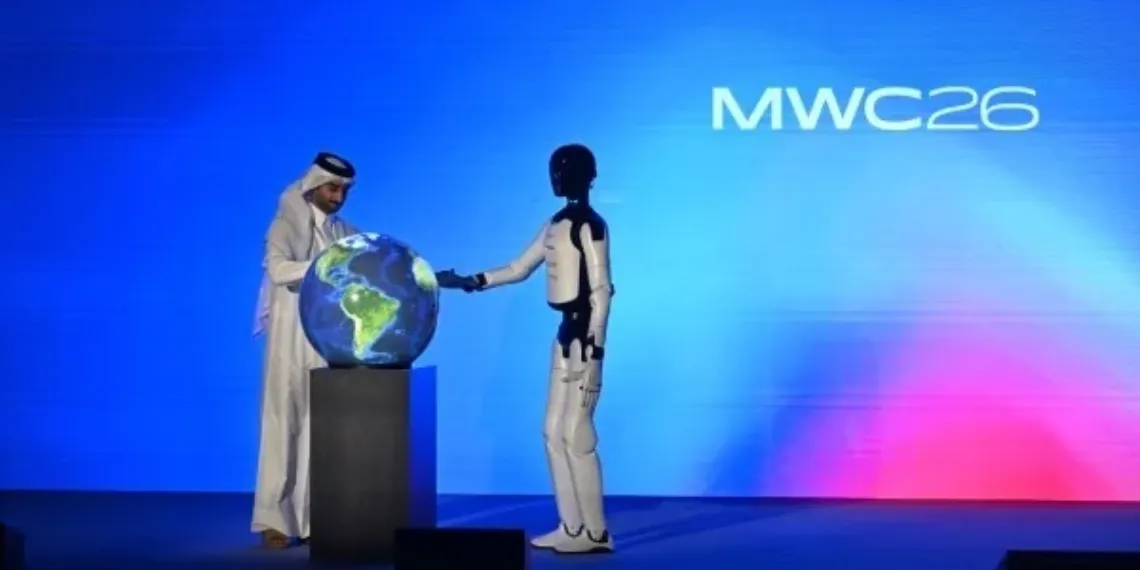
That contrast emerged at the opening of MWC Doha 2026 on 8 November, where telecommunications executives and policymakers called for stronger international cooperation on industry standards and wider internet adoption.

Research released alongside the event illustrates the scale of the challenge. In 2025, 48% of MENA’s population used mobile internet, while 49% remained offline despite living within coverage, according to GSMA’s Mobile Economy MENA 2026 report.
At the same time, mobile technologies and services generated $380 billion in economic value across the region, equivalent to 5.8% of GDP. Their annual economic contribution is forecast to reach $470 billion by 2030.
Coverage is only part of the challenge
The findings draw an important distinction between extending networks and increasing their use.
People outside coverage need access to infrastructure. Those already within coverage but not using mobile internet present a different challenge, one that additional network deployment alone cannot resolve.
For operators and policymakers, that means the region’s progress needs to be measured through adoption as well as network reach.
GSMA Director General Vivek Badrinath addressed those priorities in an opening-day discussion with International Telecommunication Union Secretary-General Doreen Bogdan-Martin.
“Progress only counts if everyone shares in it,” Badrinath said.
He called for coordinated efforts to connect people who remain offline and continued commitment to global standards that allow networks, services and devices to work across borders.
Qatar sets out infrastructure priorities
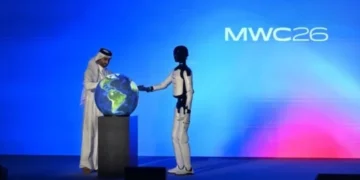
The second edition of MWC Doha opened at the Doha Exhibition and Convention Centre in the presence of Sheikh Saoud bin Abdulrahman Al-Thani, Deputy Prime Minister and Minister of State for Defence Affairs.
Organised by the GSMA in partnership with Qatar’s Ministry of Communications and Information Technology, the event runs until 10 November.
In his welcome address, Minister of Communications and Information Technology Mohammed bin Ali Al Mannai said AI was changing the requirements placed on telecommunications infrastructure.
“The need for more resilient networks and advanced computing capabilities continues to grow,” he said.
Al Mannai highlighted the development of 6G, closer integration between terrestrial, submarine and satellite networks, and broader access to computing capacity. Diversifying connectivity routes and maintaining service continuity were also priorities.
He said Qatar was continuing to invest in these areas under its Digital Agenda 2030, strengthening national capabilities and creating opportunities for innovation and investment.
Turning 5G adoption into a commercial return
Alongside the mobile economy report, the GSMA released 5G Monetisation MENA, examining how operators can generate sustainable revenue from their network investments.
Commercial 5G services had launched in 17 of the region’s 24 markets by September 2026. The number of connections is forecast to rise from 67 million in 2025 to almost 350 million by 2030.
The report identifies fixed wireless access as an emerging route to additional consumer revenue. The service uses mobile networks to deliver broadband to homes and businesses, allowing operators to compete for a different category of customer spending.
Around 64% of MENA’s commercial 5G networks already offer fixed wireless access.
The commercial question is increasingly what customers will use these networks for, and which services can support the cost of continuing investment.
Industry discussions meet international policymaking
MWC Doha’s opening also precedes the start of ITU’s Plenipotentiary Conference, PP-26, at the same venue.
Hosted by Qatar’s Communications Regulatory Authority on behalf of the State of Qatar, PP-26 runs from 9 to 27 November. Held every four years, the conference sets ITU’s overall direction, determines its strategic and financial plans, and elects its leadership.
The events retain distinct purposes, but their overlap puts technology companies, operators and policymakers within reach of one another as they discuss the sector’s future.
As examined in Rasmal’s earlier coverage of MWC Doha and the digital economy, those discussions connect questions of infrastructure and investment with the policies shaping how technology is deployed.
The research released in Doha gives that conversation a clear regional context. MENA has a growing mobile economy and an expanding 5G market. Its next phase of development will also depend on reaching the people who remain offline, including those already living within network coverage.
Rasmal is a media partner of MWC Doha 2026. This article is based on the GSMA’s 8 November announcement and Qatar News Agency’s reporting.
Follow us on Instagram, LinkedIn, and Twitter for startup & business news and inspiring stories of MENA businesses, entrepreneurs, startups, innovators, investors, and change-makers.
To report any issue or error in the story, please email us editor [at] rasmal [dot] com.
Last Updated on November 9, 2026 by Safiya K