


After more than 15 years navigating FMCG distribution, retail operations, startup innovation, and digital commerce across Qatar and the broader region, one fundamental truth has emerged with absolute clarity: understanding your customer has evolved from competitive advantage to business imperative; it now represents the defining factor between market leaders and market casualties.
In my current role, spearheading business development and omnichannel strategy for a rapidly expanding hypermarket, I have witnessed a remarkable transformation. Retailers who commit to sophisticated segmentation strategies, particularly those leveraging behavioural data and artificial intelligence, are not merely outperforming their competitors; they are redefining what growth looks like. The most successful implementations have generated sales increases of 30–40%, achieved simply through precision targeting: delivering the optimal message to the right customer at the perfect moment.


TL;DR | Executive Summary
For the executive on the move, here is the strategic summary:

- Behavioural segmentation drives 30-40% sales growth when retailers move beyond basic demographics to target customers based on actual shopping patterns and cultural preferences.
- Four proven customer segments deliver results in Qatar: Frequent flyers (routine shoppers), Deal chasers (discount-driven), Occasional splurgers (cultural event buyers), and Loyalists (programme-engaged customers).
- Technology is not the barrier—strategic thinking is: Mid-tier retailers can achieve 35%+ growth improvements using existing data and basic analytics, without major system overhauls.
- Cultural intelligence separates winners from losers: Success requires aligning segmentation strategies with Qatar’s unique shopping calendar, from Ramadan patterns to National Day celebrations.
Beyond Demographics: The Precision Revolution
Qatar’s retail landscape has long operated on rudimentary segmentation principles: male versus female, affluent versus middle-market, youth versus family demographics. This approach served adequately in simpler times, but today’s consumer reality renders such broad categorisation not just insufficient, but it is counterproductive.
Modern customers defy neat categorisation. Their purchasing behaviour fluctuates across seasons, evolves through life stages, and varies even within daily cycles. They seamlessly transition between physical stores and digital platforms, respond selectively to targeted offers, and engage differently depending on the channel and context.
Yet remarkably, numerous retailers continue deploying marketing strategies that would have been considered outdated a decade ago. The inevitable consequences? Diminished engagement rates, stagnating loyalty programme performance, and substantial budget waste.
This is precisely where intelligent segmentation, driven by behavioural analytics and machine learning, transforms from concept to competitive weapon.
Segmentation in Action: Real Strategy, Measurable Impact
Several months ago, I led our internal team through a comprehensive customer base analysis. Rather than defaulting to traditional demographic divisions, we reconstructed our understanding around observable customer behaviours:
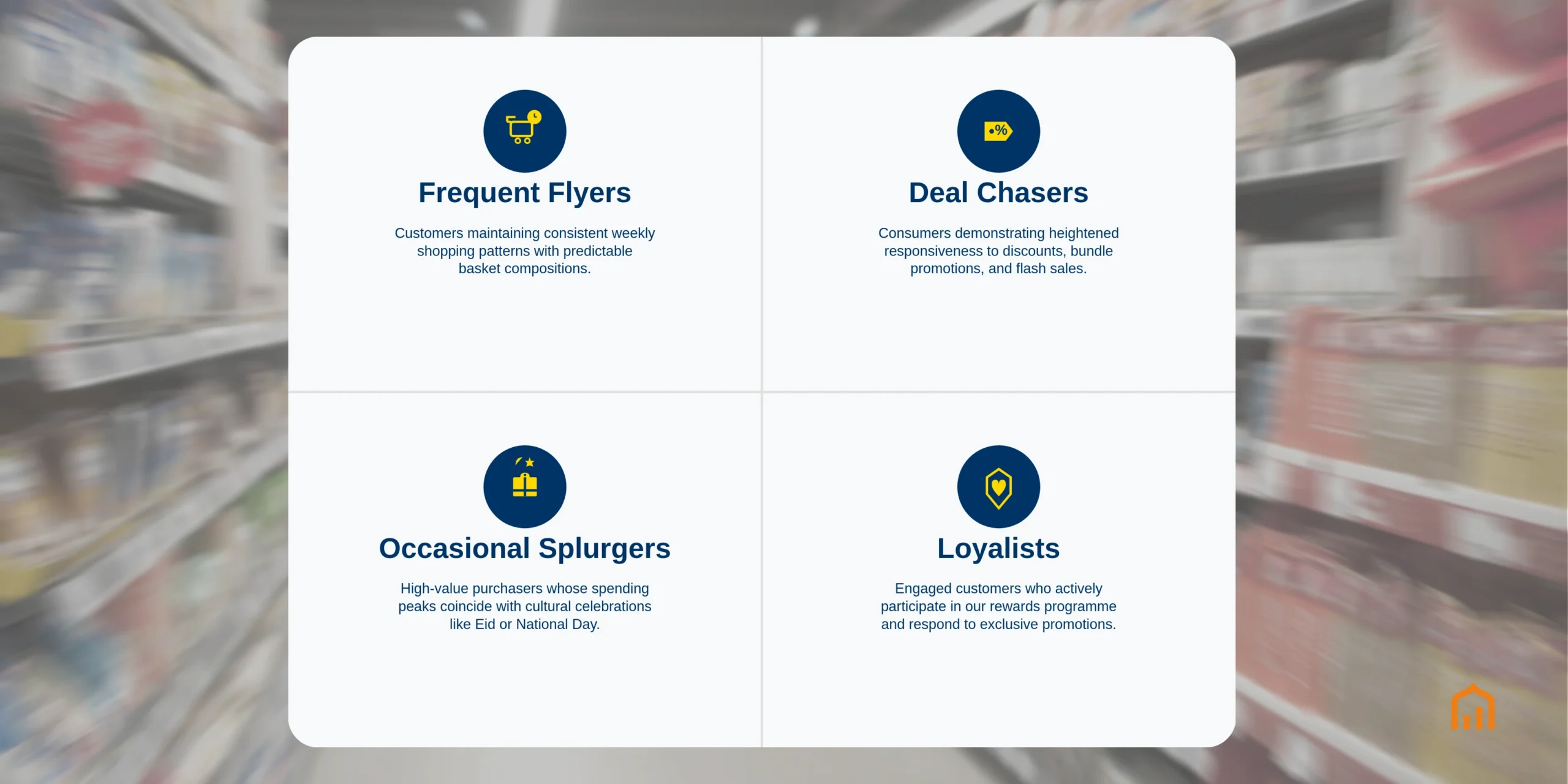
Frequent flyers: Customers maintaining consistent weekly shopping patterns with predictable basket compositions
Deal chasers: Consumers demonstrating heightened responsiveness to discounts, bundle promotions, and flash sales opportunities
Occasional splurgers: High-value purchasers whose spending peaks coincide with cultural celebrations like Eid or National Day
Loyalists: Engaged customers who actively participate in our rewards programme and respond enthusiastically to exclusive promotional offerings
Our strategic response involved tailoring both communication strategies and promotional offers to each distinct group. Loyalists received privileged early access to new product launches. Deal chasers became primary targets for time-sensitive “48-hour bundle” campaigns. High-spending customers received exclusive invitations to curated in-store experiences.
The transformation was unmistakable within a single quarter:
- Conversion rates achieved substantial improvement
- Customer repeat visit frequency increased markedly
- Revenue generated from these targeted segments exceeded previous performance by significant margins
The Qatar Advantage: Cultural Intelligence as Strategy
Mastering the Qatari consumer requires sophistication that transcends conventional CRM methodologies. Success demands deep appreciation for cultural subtleties, acute awareness of seasonal behavioural shifts during Ramadan and Eid, and recognition of evolving digital engagement patterns. The proliferation of platforms like Talabat, Snoonu, Rafeeq, combined with sophisticated e-commerce loyalty ecosystems, has created unprecedented data accessibility for retailers.
However, data transforms into strategic value only through structured interpretation and decisive action.
This represents the critical juncture where most businesses falter, not due to technological limitations, but because they lack the internal expertise to translate available tools into localised, strategically coherent approaches.
Field Validation: The Fashion Retail Transformation
I recently collaborated with a mid-tier fashion retailer confronting declining store traffic and deteriorating loyalty programme engagement. Our approach began modestly: integrating existing loyalty data with e-commerce browsing behaviour patterns. Through basic machine learning clustering techniques, sophisticated enough to be effective, simple enough to be practical, we identified three distinct consumer segments:
- Style-seekers: High engagement browsers with consistently low conversion rates
- Brand loyalists: Customers demonstrating repeat purchasing behaviour within specific brand preferences
- Last-minute gifters: Consumers whose purchasing activity concentrates around holiday periods
Each segment received customised messaging, differentiated promotional offers, and in select cases, personalised digital experiences. The results spoke definitively: sales grew by over 35% within three months, while their loyalty programme redemption rate doubled. Notably, these improvements required no significant technological infrastructure changes, merely strategic clarity and execution discipline.
Technology as Enabler: The Mindset Revolution
The most persistent misconception I encounter suggests that AI-powered segmentation remains exclusive to large retail chains with substantial technology budgets. This assumption is categorically false. The determining factor is strategic mindset: the willingness to transition from assumption-based decisions to data-informed strategy.
Even retailers operating without an extensive technological infrastructure can begin with fundamental approaches:
- Systematically tracking customer behaviour across both physical store visits and digital platform interactions
- Creating customer groups based on spending patterns, purchase recency, and category preferences
- Deploying targeted, contextually relevant communications rather than generic promotional messaging
This foundation enables genuine results and sustainable growth.
The Path Forward: Qatar’s Retail Evolution
Qatar’s retail sector stands at a pivotal moment. Consumer expectations continue their upward trajectory. Brand loyalty requires increasingly sophisticated cultivation. Competitive threats emerge with unprecedented speed and accessibility.
However, retailers who embrace intelligent segmentation principles, those who abandon mass-market thinking in favour of behaviour-based strategy, will transcend mere survival. They will achieve substantial growth, potentially reaching the 30-40% improvements we have already documented in the marketplace.
Strategic Imperatives for Retail Leadership
My recommendations for fellow retail executives across Qatar:
- Begin immediately with existing data assets; perfection should not prevent progress
- Develop foundational segments first, then advance systematically through increased sophistication
- Cultivate team expertise in customer experience thinking rather than a transactional focus
- Position AI as strategic support for professional intuition, not a replacement for human insight
- Maintain local relevance by aligning all initiatives with Qatar’s cultural rhythms and shopping calendar patterns

The Relationship Economy
Contemporary retail has fundamentally shifted: we operate within the relationship economy, not merely the transaction economy. Every customer insight generated, every personalised experience delivered, strengthens the foundation for sustained customer engagement and loyalty.
For retail leaders committed to scaling performance within Qatar’s dynamic market, intelligent segmentation has moved beyond optional strategy; it now represents the definitive competitive advantage.
The opportunity exists today. The question remains whether Qatar’s retail leadership will seize it.
About the Author
Abdul Ali is a seasoned business development and retail growth specialist based in Doha, Qatar, with over fifteen years of proven experience driving FMCG distribution, hypermarket expansion, and omnichannel strategy across the GCC region. As a current business development manager specialising in distribution, retail operations, and omnichannel solutions, Abdul Ali has helped numerous Qatar-based distributors & retailers achieve substantial growth through data-driven customer segmentation and culturally intelligent marketing strategies.
Ready to unlock the next stage of your retail growth? Connect with Abdul Ali to explore how behavioural segmentation can transform your Qatar market performance.
- Connect on LinkedIn: www.linkedin.com/in/abdulali1
- Explore more insights: www.abdulali.me
- Book a 15-Minute Strategy Call: calendly.com/abdulalii
Last Updated on August 8, 2025 by Safiya K


